Line of Credit Software for Subprime Lending: How SparkLMS Powers Revolving Credit at Higher Risk Tiers

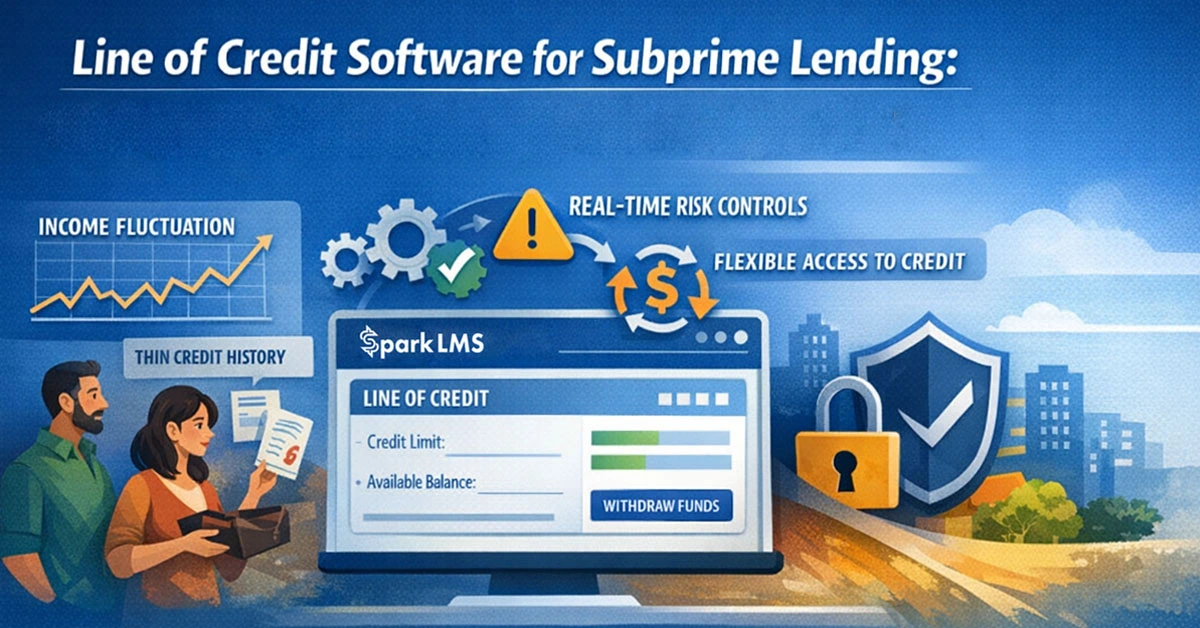
Subprime and near-prime borrowers don’t fit neatly into traditional lending models. Income can fluctuate. Credit histories may be thin. Financial needs often show up unexpectedly.
Fixed installment loans assume stability. In dynamic risk environments, that assumption can create more pressure than protection. What works better is controlled, flexible access to smaller amounts of credit, something borrowers can use when needed without being locked into rigid structures.
Line of Credit (LOC) products can meet that need. But in higher-risk tiers, flexibility must be matched with strong, real-time risk controls. SparkLMS is designed to support that balance.
Also Read: Empowering Tribal Lenders with Complete Control
Installment loans are built on predictability. Subprime borrowers often live in the opposite reality. Income can fluctuate from week to week. Expenses don’t wait for payday. A rigid repayment schedule can quickly become a stress point.
An LOC offers something different. Instead of one large disbursement, borrowers can access smaller amounts as needed. They borrow only what makes sense at the moment and repay gradually, restoring available credit over time.
For lenders, this structure lowers risk per transaction while creating long-term engagement. But it only works when the system behind it can manage balances, limits, and risk dynamically.
The stability of a revolving credit program depends heavily on its structure behind the scenes. When LOC models are forced into installment-loan frameworks, operational strain tends to follow.
SparkLMS loan software approaches this differently. A Line of Credit is modeled as a persistent revolving account rather than a sequence of short-term loans recreated after each repayment.
Instead of reopening accounts repeatedly, lenders manage one continuous credit relationship. Borrowers can take multiple advances under the same credit line, while balances, repayments, and fees update the same account in real time.
There is no artificial reset at payoff. Risk is monitored continuously rather than resetting with each loan cycle. Risk controls adjust as borrower behavior changes, without having to rebuild the structure each cycle.
In subprime portfolios, where patterns shift month to month, that architectural distinction makes a meaningful difference.
In subprime lending, risk does not stay still. Borrowers draw funds, make partial repayments, and sometimes miss payments. Outstanding balances change constantly, which makes real-time control essential.
Many borrowers in this segment rely on smaller, short-term advances rather than large one-time loans. Supporting that pattern safely requires allowing multiple low-value drawdowns while validating availability at every step.
SparkLMS supports risk control across three stages of the credit lifecycle.
Every draw request is checked against current availability. This helps prevent accidental over-advances, which are a major operational risk in non-prime revolving credit.
Rather than relying only on initial underwriting, lenders manage risk continuously throughout the account lifecycle.
In higher-risk segments, transparency is not optional. It affects trust, repayment behavior, and regulatory risk. When pricing is unclear or repayment expectations are rigid, friction rises quickly.
Rigid installment schedules create pressure where income fluctuates. An LOC works better when repayment structures reflect real borrower behavior.
SparkLMS supports repayment models that reduce stress while maintaining control.
Pricing also needs careful structure. In higher-risk portfolios, opaque fee models increase both regulatory risk and borrower dissatisfaction.
Borrowers can clearly see their credit limit, available balance, minimum payment due, and transaction history through web and mobile access. That visibility reduces confusion and supports more consistent repayment behavior.
In alternative lending environments, the collection strategy can determine whether a portfolio stabilizes or deteriorates. A rigid, closure-first approach often limits recovery and shortens customer lifetime value. Rehabilitation tends to produce better outcomes than immediate shutdown.
SparkLMS supports collections workflows built around minimum-payment tracking rather than full balance triggers. This allows lenders to intervene early, without permanently severing the credit relationship.
Beyond individual accounts, portfolio visibility becomes critical. Subprime risk patterns shift quickly, and static reporting is not enough.
This combination of operational controls and portfolio intelligence allows lenders to adjust limits, pricing, and policies based on real borrower behavior rather than assumptions.
Subprime lending demands more than flexible credit. It requires infrastructure that adapts as borrower behavior and exposure change. An LOC model can improve outcomes in higher-risk segments, but only when flexibility is paired with disciplined controls and clear visibility.
SparkLMS enables lenders to scale subprime Line of Credit programs responsibly and sustainably.