Line of Credit Loan Management Software: How SparkLMS Powers Modern Revolving Credit Products

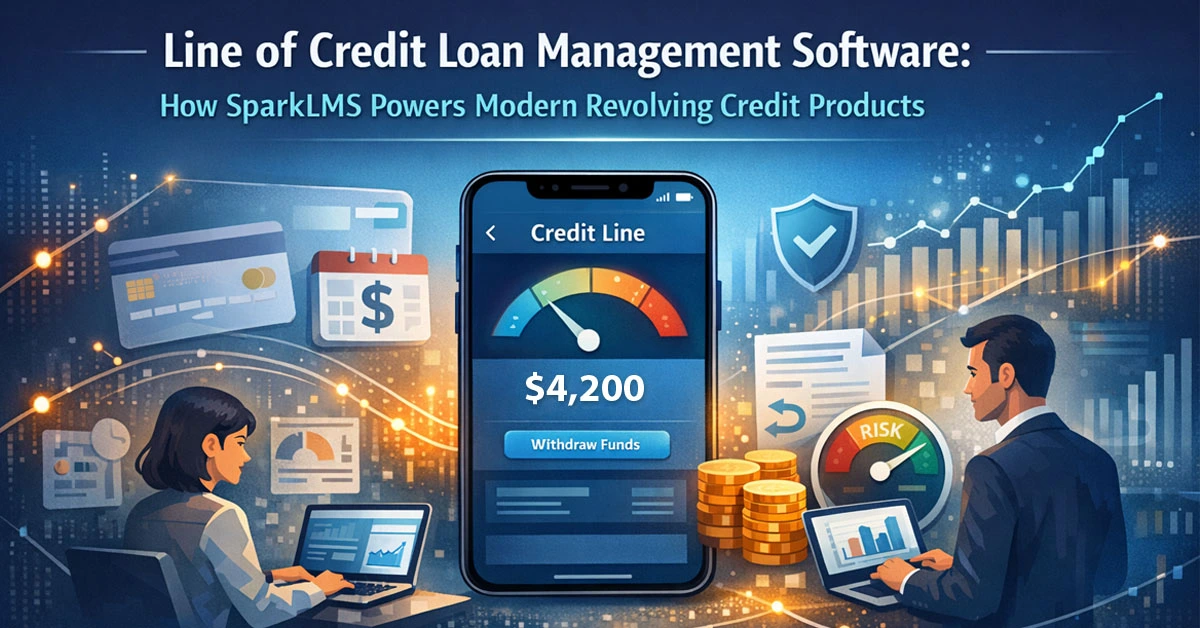
Borrowers don’t always need a large loan upfront. Often, they just need access to funds when situations change, to manage uneven cash flow, cover short-term gaps, or handle unexpected expenses. This is why Line of Credit (LOC) lending is becoming more common across modern lending portfolios.
For lenders, this creates opportunities to drive repeat usage and long-term customer value. But revolving credit is harder to service. Balances and exposure change constantly, and systems must stay accurate across borrower and internal channels. SparkLMS is built to help lenders manage this complexity at scale.
Also Read: Line of Credit Software Explained: A Complete Guide
A Line of Credit works differently from traditional loans. Instead of receiving a fixed amount upfront, borrowers are approved for a credit limit they can use whenever funds are needed. This allows borrowers to draw smaller amounts over time, make partial or full repayments, and reuse available credit without submitting a new application each time.
Interest is usually charged only on the amount currently used, not the full approved limit. This aligns credit costs more closely with actual usage, but it also means balances and exposure can change frequently. Every draw, repayment, or fee directly affects available credit and outstanding balance.
Servicing Line of Credit accounts is, therefore, more complex than servicing term loans. Systems must track multiple transactions under a single account, calculate interest on changing balances, and maintain accurate credit visibility across borrower portals, servicing systems, and reporting tools. Lenders need infrastructure designed specifically for revolving credit.
Many loan systems try to support the Line of Credit by adapting term loan structures. Over time, this creates operational gaps. SparkLMS takes a different approach by supporting revolving credit as a native credit model.
Instead of treating a credit line as a modified loan, SparkLMS loan software models it as a long-lived revolving credit account with its own lifecycle and servicing logic.
Each credit line remains active until it is closed, suspended, or charged off. All credit activity continues under the same account, keeping the borrower experience simple and consistent.
SparkLMS updates balances and available credit automatically as activity happens.
The result is a system that naturally supports dynamic credit behavior, allowing lenders to scale revolving credit programs without adding operational complexity.
In LOC lending, risk exposure is constantly changing. As borrowers draw funds, repay balances, or incur charges, available credit and utilization shift in real time. Managing this accurately is critical for both portfolio health and borrower experience.
SparkLMS gives lenders real-time visibility and control over credit exposure throughout the lifecycle of each credit line.
SparkLMS also supports dynamic credit limit management, allowing lenders to adjust limits as borrower behavior and risk signals change.
These controls help prevent overexposure, reduce manual monitoring, and support scalable digital lending operations while maintaining consistent borrower experiences.
Line of Credit pricing must adapt to constantly changing balances. Unlike fixed-term loans, interest in revolving credit is typically charged only on the amount currently used. This requires systems to calculate interest accurately even when balances change multiple times within a billing cycle.
SparkLMS allows lenders to configure pricing structures that align with their credit strategy and regulatory requirements.
In addition to interest, SparkLMS supports flexible fee configuration aligned with different credit programs.
SparkLMS also supports a consistent digital borrower experience across web and mobile channels.
Managing Line of Credit accounts requires a different collections approach than traditional loans. Because credit lines remain active over long periods, the focus shifts toward early intervention, recovery, and long-term relationship management.
SparkLMS supports revolving credit collections strategies built around minimum payment tracking and automated workflows.
Beyond individual account servicing, the platform also provides portfolio-level intelligence to support better credit and risk decisions.
As Line of Credit lending continues to grow, lenders will need systems that can adapt to changing borrower behavior while maintaining accuracy, transparency, and scalable credit operations.
As revolving credit continues to evolve, lenders will need to make faster, more data-driven decisions across the entire credit lifecycle. The ability to manage utilization, pricing, risk, and borrower engagement in real time will increasingly define competitive advantage in digital lending.